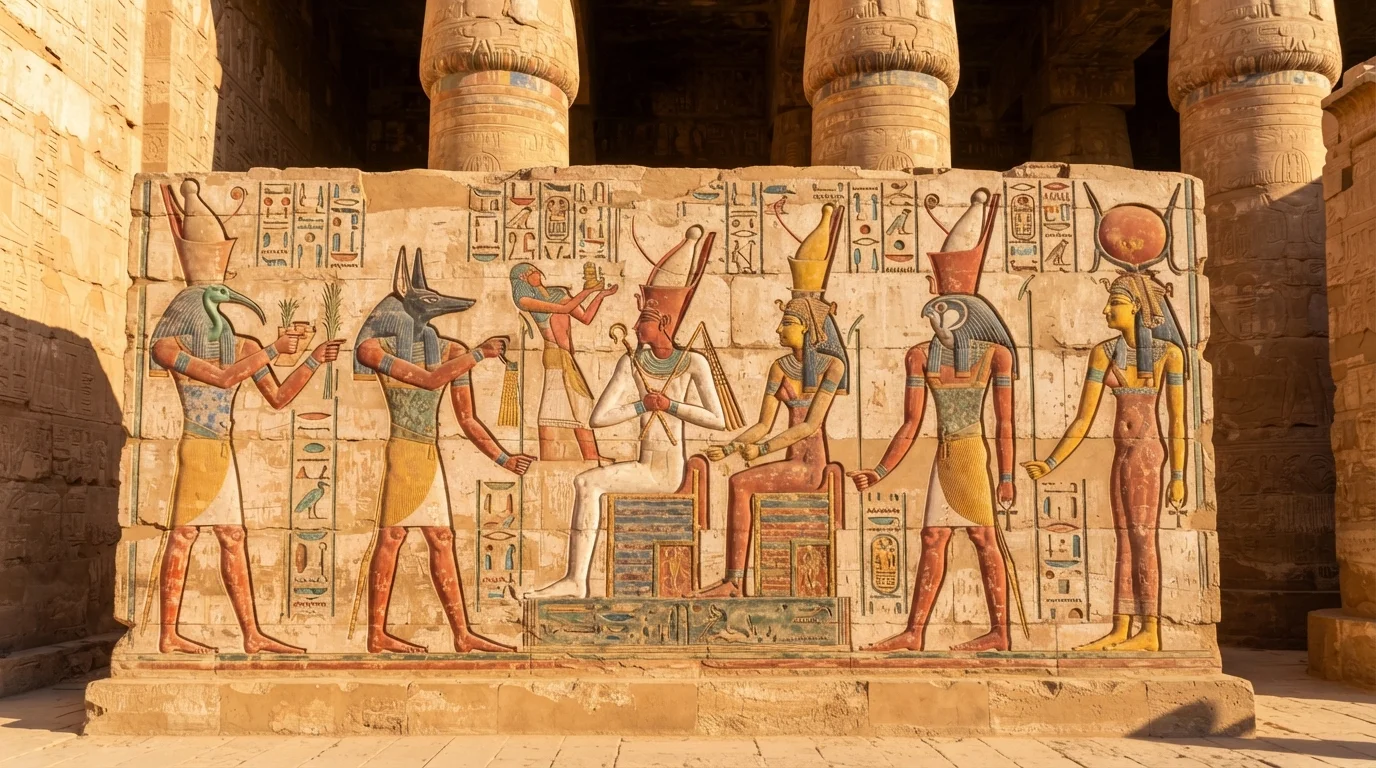
Walk into any temple in Egypt and you are surrounded by the ancient Egyptian gods: falcon-headed Horus on a pylon, cow-eared Hathor crowning a column, jackal-headed Anubis bending over a mummy in a tomb. To many visitors, they can feel like a confusing crowd. Once you know who the main figures are and what they stood for, the walls start to tell stories, and every temple visit becomes richer.
This guide introduces the most important ancient Egyptian gods, explains how Egyptian religion worked, retells the key myths and shows where in Egypt you can still see each god today.
Ancient Egyptian Gods at a Glance
Egyptian religion had a huge number of deities. Encyclopaedia Britannica counts some 1,500 named gods and goddesses, a pantheon that changed over more than 3,000 years, according to its overview of the major Egyptian deities. You do not need to know them all. A dozen or so appear again and again in the temples you are most likely to visit.
| God | Role | How to recognize them | Where to see them |
|---|---|---|---|
| Ra / Amun-Ra | Sun, creation, kingship of the gods | Falcon head with sun disk / man with tall plumes | Karnak, Valley of the Kings |
| Osiris | Death, rebirth, the afterlife | Mummified king, green skin, crook and flail | Abydos, Philae |
| Isis | Magic, motherhood, protection | Woman with throne-shaped crown | Philae |
| Horus | Kingship, the sky | Falcon or falcon-headed man | Edfu, Kom Ombo |
| Hathor | Love, music, joy | Cow, or woman with cow ears and sun disk | Dendera, Hatshepsut temple |
| Anubis | Embalming, guide of the dead | Jackal or jackal-headed man | Tombs, Hatshepsut temple |
How Egyptian Religion Worked?
Before meeting the gods one by one, it helps to understand how the Egyptians thought about them.
Many Gods, Many Forms
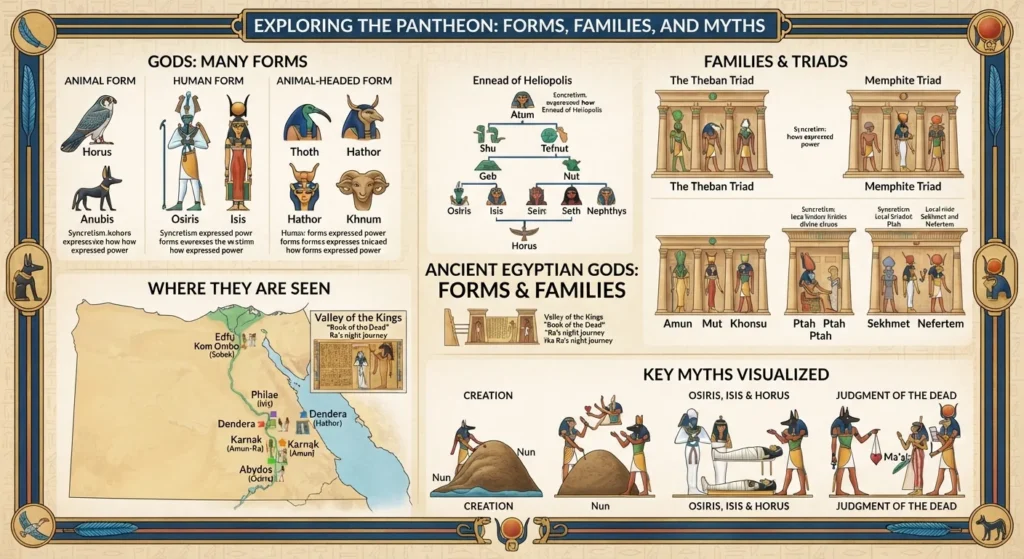
The ancient Egyptian gods were not neatly defined. A single god could take many forms, and several gods could merge into one, a process scholars call syncretism. The sun god Ra, for example, combined with Amun to become Amun-Ra and with Horus to become Ra-Horakhty. Gods could appear as animals, as humans or as humans with animal heads, each form expressing a different aspect of their power.
Local Gods and Families
Most gods began as local deities linked to particular towns. Over time, priests grouped them into families. Thebes honored the triad of Amun, Mut and Khonsu; Memphis honored Ptah, Sekhmet and Nefertem. The most famous grouping was the Ennead of Heliopolis, a family of nine gods descended from the creator Atum, including Osiris, Isis, Seth and Nephthys. Many of the best-known ancient Egyptian gods belong to this family.
The King and the Temples
Temples were the homes of the gods, not places for public worship. Priests cared for the god’s statue each day, washing, dressing and feeding it. The king was the link between the people and the ancient Egyptian gods: in theory he performed every ritual, which is why temple walls show the pharaoh making offerings again and again.
The Major Ancient Egyptian Gods
These thirteen deities are the ones you will meet most often on a trip to Egypt.
Ra and Amun-Ra
Ra was the sun god and creator, sailing across the sky by day and through the underworld by night. Amun, originally a local god of Thebes, rose to national importance in the New Kingdom and merged with Ra as Amun-Ra, king of the ancient Egyptian gods. Karnak was his greatest temple.
Osiris
Osiris was god of the dead, rebirth and fertility, usually shown as a mummified king with green or black skin, holding a crook and flail. Every Egyptian hoped to become one with Osiris after death. His main cult center was Abydos, and no figure among the ancient Egyptian gods mattered more to ordinary people’s hopes for the afterlife.
Isis
Isis, wife of Osiris and mother of Horus, was a goddess of magic, healing and devoted motherhood. She became one of the most popular of all the ancient Egyptian gods, and her worship spread across the Roman Empire. Philae was her most important temple.
Horus
Horus, the falcon-headed son of Osiris and Isis, was god of kingship and the sky. Every living pharaoh was considered the earthly Horus. His best-preserved temple is at Edfu, where granite falcons guard the entrance.
Seth
Seth was god of storms, the desert and chaos. He murdered his brother Osiris and fought Horus for the throne, but he was also a powerful protector who defended the sun god’s boat against the serpent Apophis. That double nature makes him one of the most complex of the ancient Egyptian gods.
Hathor
Hathor was goddess of love, music, dance and joy, shown as a cow or as a woman with cow’s ears. She was also a protector of the dead in the Theban hills. Her finest temple is at Dendera, where her face crowns every column. She was one of the best-loved of the ancient Egyptian gods.
Anubis
Jackal-headed Anubis was god of embalming and the guide of souls. In the judgment of the dead, he tended the scales on which the heart was weighed against the feather of Ma’at. He appears in almost every tomb you will visit, and he is often the first of the ancient Egyptian gods that children recognize.
Thoth
Thoth, shown as an ibis-headed man or a baboon, was god of writing, wisdom and the moon. He recorded the result of the judgment of the dead and was patron of scribes. Of all the ancient Egyptian gods, he is the one most closely linked to hieroglyphs themselves.
Ptah
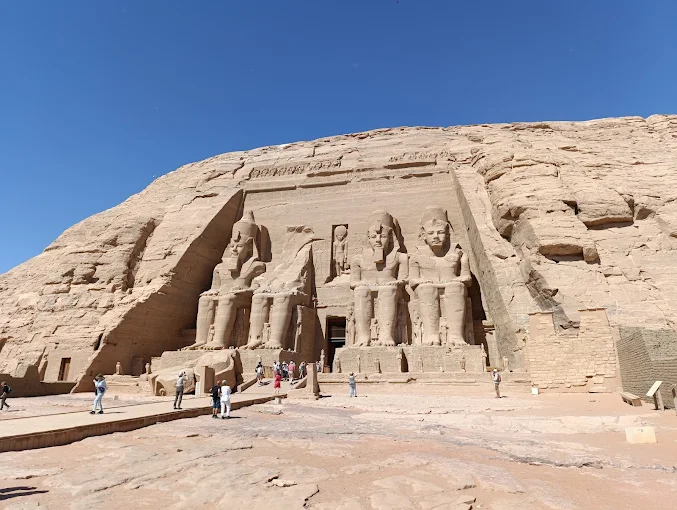
Ptah, a mummiform figure with a skullcap, was the creator god of Memphis and patron of craftsmen. He appears in one of the sanctuaries at Abu Simbel, seated beside Amun-Ra, Ra-Horakhty and the deified Ramesses II.
Sobek
Sobek, the crocodile god, was linked to the Nile, fertility and royal power. He shares his temple at Kom Ombo with Haroeris, Horus the Elder, and a museum there displays the crocodiles mummified in his honor.
Bastet
Bastet, shown as a cat or a cat-headed woman, was a protective goddess of the home and of women. Cats were sacred to her, and many were mummified as offerings. Few of the ancient Egyptian gods are as instantly appealing to visitors today.
Ma’at
Ma’at was the goddess of truth, justice and cosmic order, shown with an ostrich feather on her head. Her feather was the standard against which the hearts of the dead were weighed. Among the ancient Egyptian gods, she represented the order every king was meant to uphold.
Other Gods You Will Meet
Look also for Mut, wife of Amun, with a vulture headdress; Khnum, the ram-headed creator who shaped people on a potter’s wheel; Sekhmet, the lion-headed goddess of war and healing; and Bes, the dwarf god who protected households and mothers. These lesser-known ancient Egyptian gods often appear in the corners of reliefs, so they are worth looking out for.
The Great Myths
The ancient Egyptian gods come alive through a few key stories that appear again and again in temples and tombs.
Creation
In the beginning, the Egyptians believed, there was only Nun, a dark ocean of chaos. A mound of earth rose from the water, and on it the creator god, often Atum or Ra, brought the other gods into being. Different cities told the story differently: at Memphis, Ptah created the world by thought and speech. Each version placed the local god at the head of the ancient Egyptian gods.
Osiris, Isis and Horus
Osiris ruled Egypt wisely until his jealous brother Seth murdered him and scattered his body. Isis searched the land, gathered the pieces and, with the help of Anubis, made the first mummy. She conceived their son Horus, who grew up to defeat Seth and claim the throne. This story explains mummification, kingship and the hope of life after death, and it is carved on walls at Edfu, Philae and Abydos.
The Sun’s Night Journey
Each evening, Ra entered the underworld in his boat, travelling through twelve hours of darkness, battling the serpent Apophis and being reborn at dawn. These scenes cover the walls of the royal tombs in the Valley of the Kings, where the king hoped to join the sun’s journey forever. No other place shows the ancient Egyptian gods in such vivid color.
Where to See the Ancient Egyptian Gods Today?
The best way to understand the ancient Egyptian gods is to stand in their temples.
Karnak and Luxor Temple
Karnak was the home of Amun-Ra, Mut and Khonsu, and Luxor Temple hosted the Opet Festival that celebrated them. Look for Amun’s tall plumed crown on almost every wall; Karnak is the best single introduction to the ancient Egyptian gods.
The Valley of the Kings and Hatshepsut’s Temple
Royal tombs show Ra’s night journey, Osiris, Anubis and the goddess Nut stretched across the ceiling. At Deir el-Bahari, Hatshepsut’s temple has fine chapels to Hathor and Anubis.
Edfu, Kom Ombo and Philae
On a Nile cruise between Luxor and Aswan, you meet Horus at Edfu, Sobek and Haroeris at Kom Ombo and Isis at Philae, three of the best places in Egypt to see the ancient Egyptian gods in their own homes.
Dendera and Abydos
North of Luxor, Dendera is the temple of Hathor, and Abydos is the city of Osiris, where Seti I built seven chapels to seven gods.
Museums
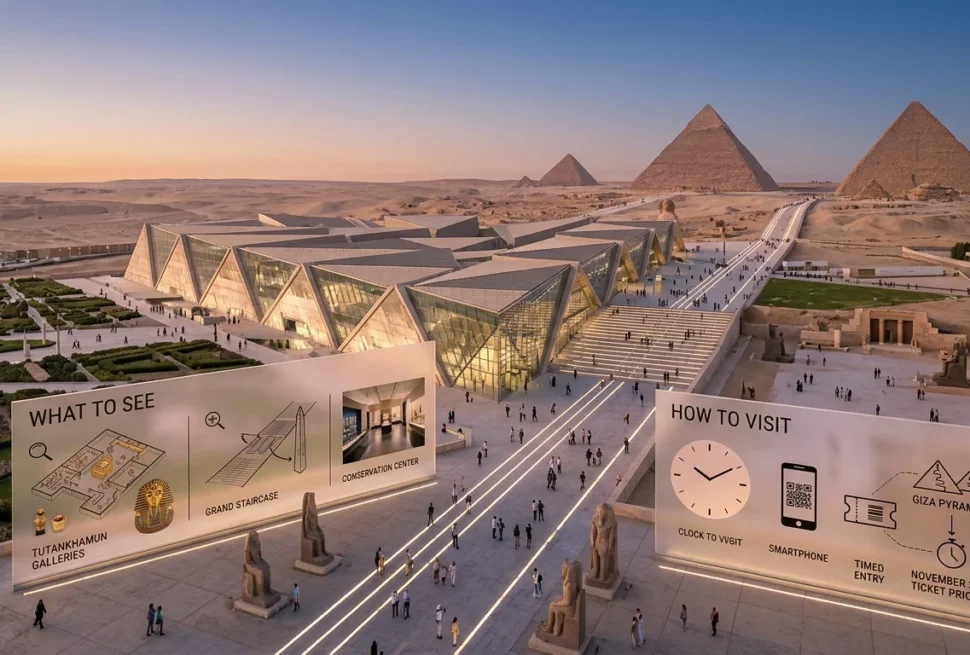
The Grand Egyptian Museum near Giza displays statues, amulets and coffins covered in images of the gods, including treasures from Tutankhamun’s tomb. It is the best place to see the ancient Egyptian gods up close in small, portable objects.
Three Trips Built Around the Gods
These examples show how different travelers might follow the ancient Egyptian gods around Egypt. They are illustrations, not fixed tours.
The classic cruise. A couple on a Nile cruise visits Karnak, the Valley of the Kings, Edfu, Kom Ombo and Philae, meeting Amun, Ra, Horus, Sobek and Isis in turn.
The Osiris trail. A history enthusiast based in Luxor takes a day trip to Abydos and Dendera to see the city of Osiris and the temple of Hathor.
A family introduction. A family visiting from the Red Sea joins a Luxor day trip and plays a game of spotting the ancient Egyptian gods on the walls of Karnak and the royal tombs.
Frequently Asked Questions
Some 1,500 named deities are known, though most visitors only need to recognize a dozen or so major figures.
It depends on the period. Ra, the sun god, was central for much of Egyptian history, and Amun-Ra became king of the gods in the New Kingdom. Osiris and Isis were among the most popular.
Animal forms expressed a god’s qualities. Horus the falcon soared over the sky, Anubis the jackal guarded cemeteries, and Sobek the crocodile embodied the power of the Nile.
In temples such as Karnak, Edfu, Kom Ombo, Philae, Dendera and Abydos, in the royal tombs of the Valley of the Kings, and in museums such as the Grand Egyptian Museum.
Osiris was the god of the dead and of rebirth. After being murdered by his brother Seth, he was restored by Isis and became ruler of the underworld.
Meet the Gods in Their Temples
The ancient Egyptian gods are easier to understand than they first appear: a family of powers representing the sun, the river, life, death and order. Learn a few names and symbols, and every temple you visit becomes a story you can read.
When you are ready to see them, explore our Luxor tours, see our Nile cruise options, or contact Lovely Egypt Tours to plan a trip through the temples of the gods.