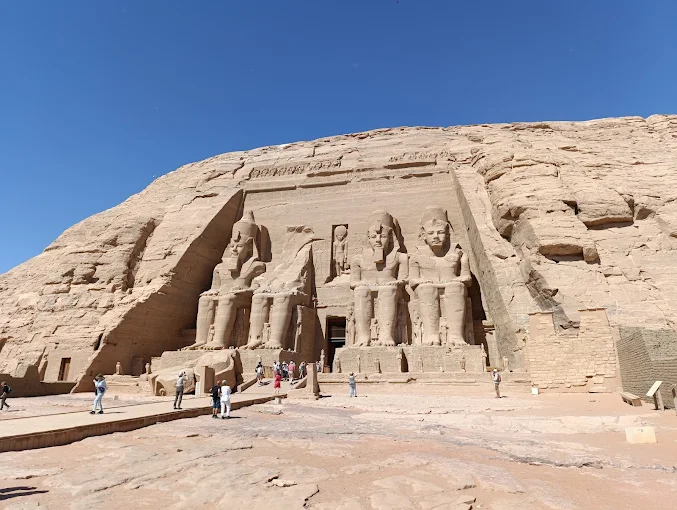
Four colossal statues of Ramesses II sit at the entrance to the Great Temple of Abu Simbel, staring out across Lake Nasser as they have done for more than 3,200 years. The temples are among the most spectacular in Egypt, and they come with one of the most remarkable stories in modern archaeology: in the 1960s, the entire site was cut into blocks and rebuilt on higher ground to save it from the rising waters of the Nile.
This guide covers the history of Abu Simbel, what you see inside both temples, how the great rescue worked, the famous sun festival, and how to plan your visit from Aswan.
Abu Simbel at a Glance
The site lies in southern Egypt, close to the border with Sudan, about 280 km south of Aswan. It has two rock-cut temples: the Great Temple of Ramesses II and the Small Temple dedicated to his queen, Nefertari, and the goddess Hathor.
| What to know | Details (verify before travel) |
|---|---|
| Location | Western shore of Lake Nasser, about 280 km south of Aswan |
| Built by | Ramesses II, 13th century BC |
| Temples | Great Temple (Ramesses II) and Small Temple (Nefertari and Hathor) |
| Relocated | 1964–1968, inaugurated at its new site in September 1968 |
| Time needed | About two hours on site; a full day from Aswan |
The History of Abu Simbel
To understand Abu Simbel, it helps to understand why a pharaoh would build such enormous temples so far from the centre of Egypt.
A Statement in Nubia
Ramesses II, one of Egypt’s most powerful and long-reigning kings, had the temples carved into a sandstone cliff beside the Nile in Nubia, a region rich in gold and trade routes. The temples were a religious monument and a political message: anyone traveling north along the river into Egypt would pass the giant figures of the king. Abu Simbel told Nubia, and the world, who was in charge.
Ramesses II and Nefertari
Ramesses dedicated the Great Temple to the gods Amun-Ra, Ra-Horakhty and Ptah, and to himself as a living god. The Small Temple honors Nefertari, his chief queen, and the goddess Hathor. It is unusual for a queen to be shown at the same scale as the king, which suggests how important Nefertari was to him.
Lost and Found
Over the centuries, sand drifted over the temples until only the heads of some statues showed. In 1813, the Swiss traveler Johann Ludwig Burckhardt saw the top of the facade and reported it. Four years later, Giovanni Belzoni dug his way into the Great Temple. The rediscovery of Abu Simbel made it one of the most famous sights in Egypt.
Inside the Temples of Abu Simbel
Both temples were cut directly into the rock, with halls and chambers reaching deep into the cliff.
The Great Temple Facade
The facade is about 30 metres high and 35 metres wide, with four seated colossi of Ramesses II, each about 20 metres tall. One of the statues lost its head and torso in an ancient earthquake, and the fallen pieces still lie at its feet. Smaller figures of the king’s family stand between the legs of the colossi, and a row of baboons, who were believed to greet the rising sun, runs along the top.
The Great Hall and the Battle of Kadesh
Inside, the first hall is lined with eight huge statues of Ramesses in the form of Osiris. The walls show the king’s military victories, most famously the Battle of Kadesh against the Hittites, in which he is shown charging in his chariot. These reliefs are some of the most dramatic in any Egyptian temple and one of the highlights of Abu Simbel.
The Sanctuary
At the heart of the temple, about 60 metres into the cliff, the sanctuary holds four seated statues: Ptah, Amun-Ra, the deified Ramesses II and Ra-Horakhty. The four figures sit side by side in a small, dim chamber, and the long walk from the bright entrance adds to the drama. Twice a year, the rising sun reaches this inner room.
The Small Temple of Nefertari and Hathor
Just north of the Great Temple, the Small Temple’s facade has six standing statues about 10 metres tall, four of Ramesses and two of Nefertari. Inside, columns topped with the face of Hathor and graceful reliefs of the queen make it one of the most elegant temples in Egypt. In one scene, Nefertari is crowned by the goddesses Hathor and Isis, an honor usually reserved for kings. Many visitors find it the most beautiful part of Abu Simbel.
The Great Rescue: Moving Abu Simbel
The story of how Abu Simbel was saved is almost as impressive as the temples themselves.
Lake Nasser and the Nubia Campaign
In the late 1950s, Egypt began building the Aswan High Dam, which would create Lake Nasser and flood much of Nubia, including dozens of ancient monuments. UNESCO launched the International Campaign to Save the Monuments of Nubia on 8 March 1960, bringing together experts and funding from around the world.
Cutting and Rebuilding
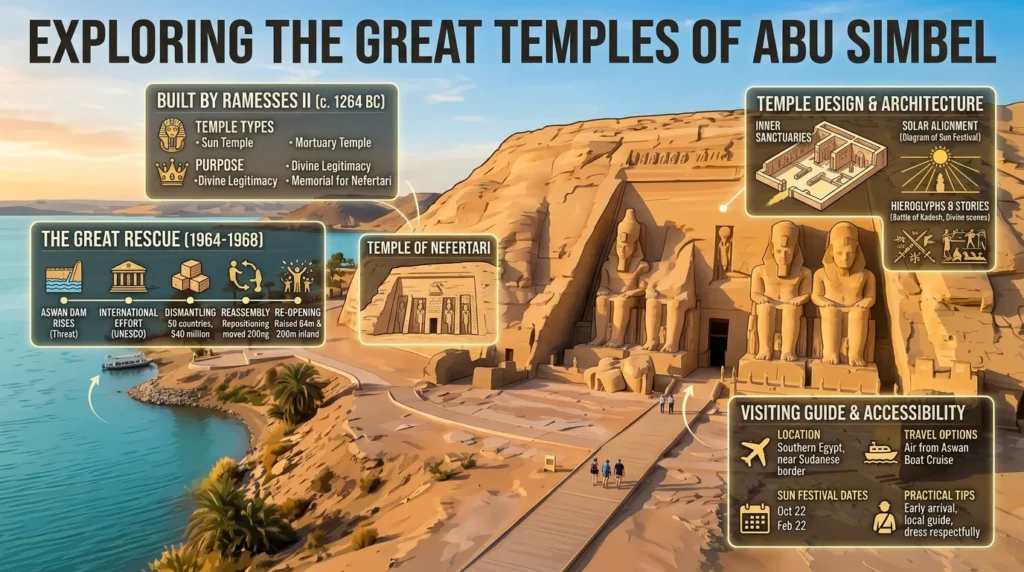
Between 1964 and 1968, engineers cut both temples into 1,035 blocks, each weighing roughly 20 to 30 tonnes, as reported by Gulf News. The blocks were reassembled about 65 metres higher and around 200 metres back from the river, inside artificial hills built over concrete domes to recreate the original cliff. According to UNESCO, Abu Simbel was inaugurated at its new location on 22 September 1968. Look closely today and you can still see some of the cut lines. The project cost about US$40 million, funded by contributions from dozens of countries, and a multinational workforce of around 2,000 people worked in desert heat that often passed 45 °C.
Philae and the Wider Campaign
The Nubia campaign rescued many other monuments too. The temples of Philae, near Aswan, were moved to Agilkia Island between 1972 and 1979, and smaller temples such as Kalabsha, Amada and Wadi es-Sebua were also relocated. Several Egyptian temples were given to countries that helped, including the Temple of Dendur, now in New York, and the Temple of Debod in Madrid.
A World Heritage Site
Abu Simbel became part of the UNESCO World Heritage Site of Nubian Monuments from Abu Simbel to Philae in 1979. The rescue also inspired the creation of the World Heritage system itself.
The Abu Simbel Sun Festival
The Great Temple was aligned so that, twice a year, the rising sun shines along its full length into the sanctuary, lighting the statues of Amun-Ra, Ramesses II and Ra-Horakhty. Ptah, a god linked to the underworld, stays in shadow. Since the relocation, this happens around 22 February and 22 October, about a day later than in the original position.
These dates draw large crowds, and many visitors arrive in the middle of the night to queue. If you want to see the sun festival at Abu Simbel, book transport and accommodation well in advance and be prepared for an early, busy morning.
Visiting Abu Simbel
A few practical decisions shape your trip.
By Road from Aswan
Most visitors travel by road from Aswan. Departures are usually very early in the morning, and the drive takes roughly three to four hours each way, so you return in the early afternoon. It is a long day, but you arrive at Abu Simbel when it is cooler and quieter.
By Air
Flights operate to Abu Simbel’s small airport, usually from Aswan and sometimes from Cairo, and transfers take visitors to the temples. Flying saves time but costs more, and schedules can change, so confirm them close to your trip.
Staying Overnight
A few travelers stay overnight in the small town nearby. This lets you see the temples at dawn or in the evening, when the site is quiet, and attend the sound and light show, where it is running.
Tickets and Timing
Tickets are sold at the site, and prices are revised periodically, so check Egypt’s official EgyMonuments site before you go. Abu Simbel is one of the hottest places in Egypt, so October to April is the most comfortable season. In summer, arrive as early as possible.
Guides and Photography
Guides usually explain the temples outside before you enter, and rules on photography and guiding inside can change, so confirm the current rules on the day.
What to Bring
Bring a hat, sunscreen, sunglasses, plenty of water and snacks for the long road journey, and a layer for the early morning, which can be cool in winter. Something to read or listen to helps pass the long drive through the desert.
Abu Simbel and Nile Cruises
Abu Simbel is not on the river route between Luxor and Aswan, but it is the most popular optional excursion from Aswan, either before or after a Nile cruise.
Three Example Visit Plans
These examples show different ways to plan a visit to Abu Simbel. They are illustrations, not fixed tours.
The classic early road trip. A couple staying in Aswan leaves before dawn, spends two hours at the temples and returns in time for a sunset felucca ride on the Nile.
The fly-in visit. A traveler with limited time flies to Abu Simbel in the morning, visits both temples and flies back the same day.
Before a Nile cruise. A family arrives in Aswan a day early to visit Abu Simbel, then boards a three-night cruise to Luxor the following day.
Frequently Asked Questions
About 280 km. The road journey takes roughly three to four hours each way, so most trips start very early in the morning.
The construction of the Aswan High Dam created Lake Nasser, which would have flooded the temples. Between 1964 and 1968, UNESCO coordinated their relocation to higher ground.
Around 22 February and 22 October each year, when the rising sun lights the inner sanctuary of the Great Temple.
About two hours is enough to see both temples. The full trip from Aswan usually takes most of a day.
For most visitors, yes. The colossal statues, the reliefs and the story of the rescue make it one of the most memorable sites in Egypt.
Plan Your Visit to Abu Simbel
Abu Simbel combines the ambition of Ramesses II with the achievement of the modern world that saved his temples. Start early, give yourself time inside both temples, and remember that you are standing on a hill built in the 1960s to keep this masterpiece above the waters.
When you are ready, see our Nile cruise options between Aswan and Luxor, explore our Egypt tours, or contact Lovely Egypt Tours to plan Abu Simbel into your trip.