
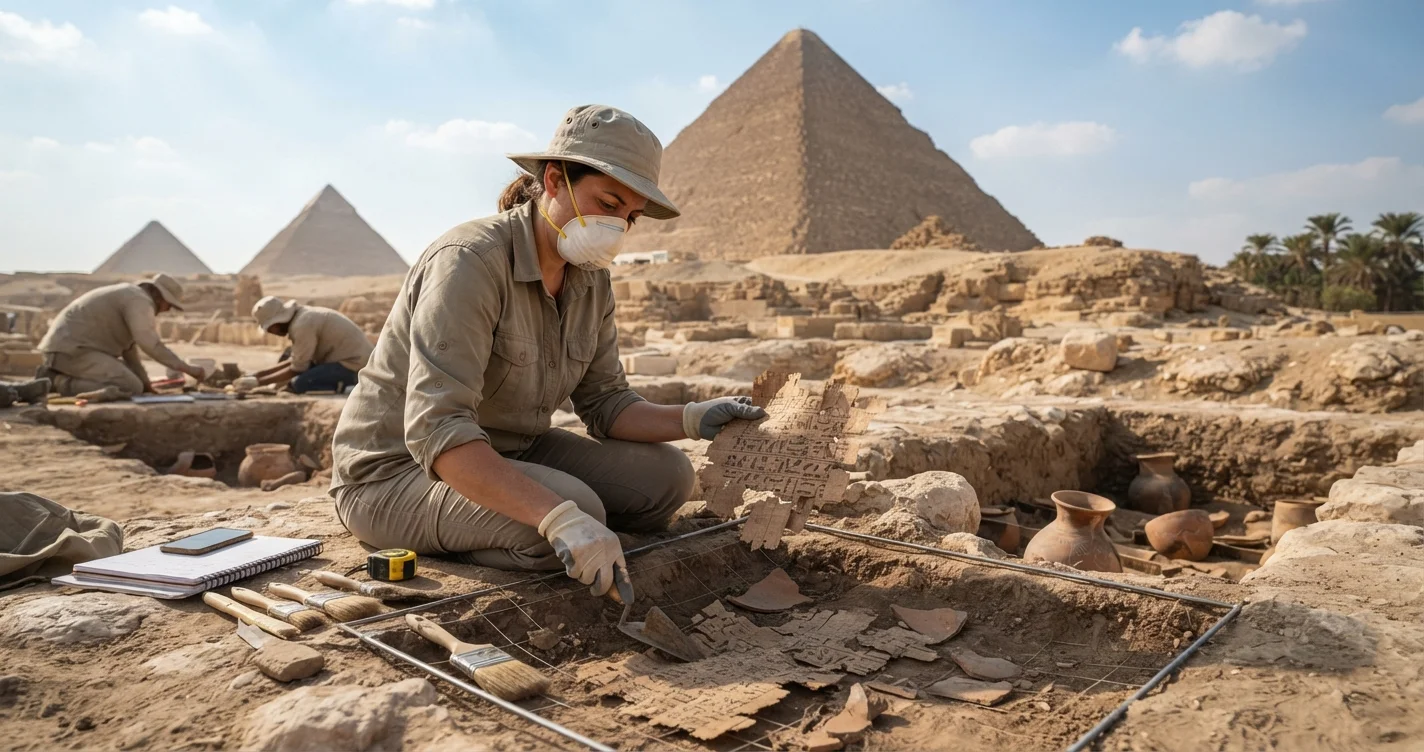
Ask a guide at Giza who built the pyramids and you will usually get two answers in one: the pharaohs who commissioned them, and the tens of thousands of Egyptians who cut, hauled and set the stone. For a long time, the second part of that answer relied on guesswork. Today it rests on hard evidence, from the excavated town where the workers lived to a logbook written by a man who shipped stone to the Great Pyramid.
This article looks at who built the pyramids from both sides, the kings and the workforce, explains how they did it, separates the myths from the evidence, and shows where you can see that evidence for yourself in Egypt.
Who Built the Pyramids? The Short Answer
The pyramids were built by ancient Egyptians during the Old Kingdom, roughly 4,700 to 4,500 years ago. Each was commissioned by a pharaoh as his tomb and overseen by senior officials, often members of the royal family. The physical work was done by a large, organized workforce of skilled craftsmen and rotating labor crews who were housed, fed and paid in goods. They were not slaves, and there is no evidence that anyone other than Egyptians was involved. That, in short, is who built the pyramids.
The Pharaohs Behind the Pyramids
To understand who built the pyramids, it helps to start with the kings, because each pyramid reflects a moment in a fast-moving story of experiment and ambition.
Djoser and Imhotep: The First Pyramid
Around 2670 BC, King Djoser’s architect Imhotep stacked six stone platforms of decreasing size at Saqqara, creating the Step Pyramid. It is widely regarded as the earliest large-scale cut-stone building in the world, and Imhotep was later revered as a sage and even a god. If the question is who built the pyramids first, the answer is Djoser’s builders at Saqqara.
Sneferu: Learning by Doing
Djoser’s successors refined the idea. Sneferu, the first king of the Fourth Dynasty, built at least three pyramids. The Bent Pyramid at Dahshur changes angle partway up, almost certainly because its builders realized the original slope was unstable. His Red Pyramid, nearby, is considered the first successful smooth-sided pyramid. Sneferu’s reign shows who built the pyramids in a very human light: engineers who made mistakes and learned from them.
Khufu, Khafre and Menkaure at Giza
Sneferu’s son Khufu built the Great Pyramid at Giza, completed around 2560 BC. Originally about 146 metres tall, it was the tallest human-made structure on Earth for thousands of years and is estimated to contain around 2.3 million blocks. Khufu’s son Khafre built the second pyramid, with the Great Sphinx nearby, and Menkaure built the third and smallest. Together they mark the peak of pyramid building, and they are what most people mean when they ask who built the pyramids.
The Workers: Who Built the Pyramids on the Ground
The more interesting part of the question is who built the pyramids with their hands. Three discoveries have transformed what we know.
The Workers’ Town
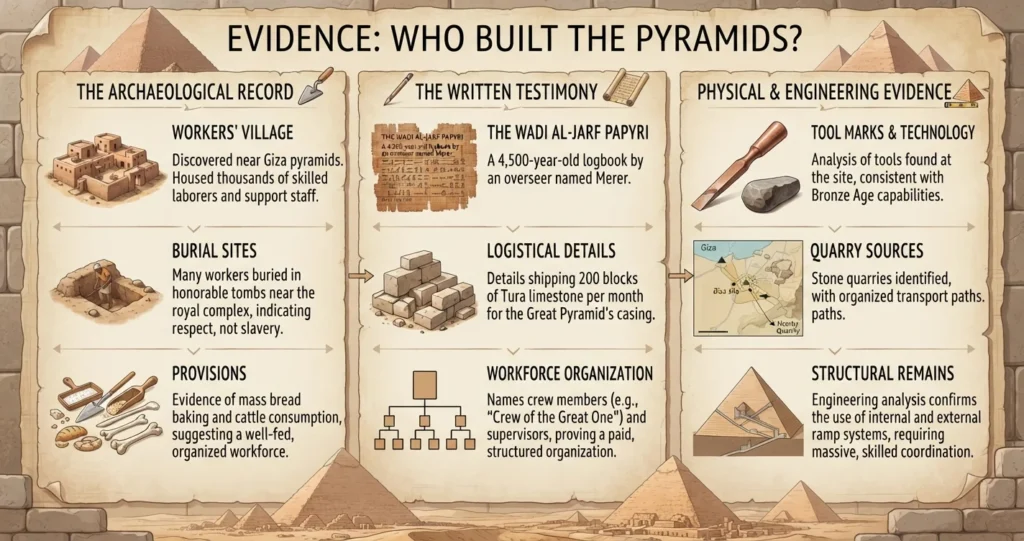
South of the Sphinx, archaeologists led by Mark Lehner have excavated a large settlement that housed and supplied pyramid workers. It includes bakeries, breweries, storage buildings and barracks-style housing, along with evidence of large-scale food production, including cattle, sheep and fish. This was a planned support city, built to keep a large workforce fed and organized. Its scale alone tells us a great deal about who built the pyramids: not a mob of captives, but a managed population with its own infrastructure.
The Builders’ Tombs
Nearby, on the slope above the town, archaeologists including Zahi Hawass uncovered the tombs of pyramid workers and their supervisors. Some held offerings of bread and beer for the afterlife, and inscriptions give workers’ titles. Skeletons show signs of hard labor but also of medical care, including healed fractures. Being buried near the king’s pyramid was an honor, which strongly argues against the idea that the people who built the pyramids were slaves.
The Diary of Merer
In 2013, a French-Egyptian team led by Pierre Tallet discovered papyri at Wadi al-Jarf, an ancient harbor on the Red Sea coast. Among them is the logbook of an official named Merer, who led a crew of about 40 men transporting limestone blocks from the quarries at Tura, across the Nile, to Giza. According to Guinness World Records, it is the oldest surviving papyrus document, and it records how his team made around ten round trips a month using a network of canals and an artificial harbor near the plateau.
The papyri also name Ankhhaf, Khufu’s half-brother, as the official overseeing this part of the work. Egypt’s antiquities ministry noted that the documents list revenues sent from the provinces to feed and pay the workers, as reported by The Times of Israel. For the first time, we can read the words of men who built the pyramids.
The Officials Who Managed the Work
Behind the workers stood a layer of administrators. Hemiunu, a royal relative and vizier under Khufu, is traditionally credited as the architect of the Great Pyramid, and his statue survives today. Ankhhaf, named in the Merer papyri, oversaw logistics in the final years. These men show that the answer to who built the pyramids includes planners, scribes and managers as well as laborers.
How the Workforce Was Organized?
Egyptologists generally think the pyramids were built by a core of skilled craftsmen working year-round, supported by larger crews of laborers who rotated in for periods of service, often from farming communities. Workers were organized into named gangs and smaller teams, some of which left their names painted on stones inside the pyramids. Estimates for the total workforce at any one time vary, but many scholars suggest somewhere in the range of 20,000 to 30,000 people for the Great Pyramid.
How They Did It: Stone, Water and Organization?
Knowing who built the pyramids leads naturally to how they did it.
Quarrying the Stone
Most of the core blocks were local limestone quarried on the Giza Plateau itself. The fine white casing stone came from Tura across the river, and granite for the burial chambers came from Aswan, more than 800 km to the south. Workers used copper tools, stone hammers and wooden levers, along with a great deal of skill. Unfinished blocks still visible in ancient quarries show exactly how the people who built the pyramids cut channels around each block and levered it free.
Moving the Blocks
The Nile and a network of canals did much of the heavy lifting. Boats carried stone close to the plateau, from where blocks were dragged on sledges. A painting in a later tomb shows workers pouring water in front of a sledge to reduce friction, an idea supported by modern experiments. Water transport also explains how the people who built the pyramids moved such huge quantities of stone to Giza.
Raising the Pyramid
Exactly how the blocks were lifted into place is still debated. Most Egyptologists favor some combination of ramps, whether straight, zigzagging up one face or wrapping around the pyramid, along with levers for final positioning. In 2018, archaeologists reported a steep ramp with post holes at the ancient alabaster quarry of Hatnub, showing that Egyptians had techniques for hauling heavy blocks up steep slopes. The debate is about method, not about who built the pyramids.
Myths vs Evidence
Few ancient monuments attract as many myths as the pyramids. Here are the most common claims about who built the pyramids, and what the evidence says.
Were the Pyramids Built by Slaves?
No. The workers’ town, the honorable burials and the administrative papyri all point to a paid and provisioned workforce. Pay took the form of bread, beer, food and other goods, because Old Kingdom Egypt did not use coins. Labor service for the state may have been compulsory for some, much like a tax, but that is very different from slavery. The idea that slaves were who built the pyramids comes largely from later writers and films, not from the archaeology.
Did the Israelites Build the Pyramids?
The Giza pyramids were completed many centuries before the period in which the biblical story of the Exodus is set, and there is no archaeological evidence connecting the two. The workers’ names, titles and tombs are Egyptian, which settles who built the pyramids far more firmly than later legends.
Aliens or Lost Civilizations?
Theories involving aliens or a lost civilization ignore the large body of evidence showing how the pyramids developed step by step, from Djoser’s Step Pyramid to Sneferu’s experiments and the Giza pyramids. The quarries, tools, workers’ town, tombs and papyri all show that Egyptians were who built the pyramids, using techniques they refined over generations.
Seeing the Evidence for Yourself
The best way to understand who built the pyramids is to see the progression on the ground.
Saqqara and Dahshur
Start at Saqqara with Djoser’s Step Pyramid, then continue to Dahshur to see Sneferu’s Bent and Red pyramids. Together they show the experiments that made Giza possible, and they are far quieter than the Giza Plateau. Walking between them is the clearest way to understand who built the pyramids and how their skills grew.
The Giza Plateau
At Giza, look for the remains of the casing stones near the top of Khafre’s pyramid, the quarries visible on the plateau, and the area south of the Sphinx where the workers’ town and tombs lie. Our guide on how to visit the Pyramids of Giza explains the current entrance, tickets and best route. A good Egyptologist guide can show you the traces left by the people who built the pyramids.
The Grand Egyptian Museum
The Grand Egyptian Museum, near Giza, displays Khufu’s solar boat and objects from the Old Kingdom, and the Diary of Merer papyri have been exhibited in Cairo. A visit puts the people who built the pyramids into context.
Frequently Asked Questions
They were built by ancient Egyptian workers for the Fourth Dynasty kings Khufu, Khafre and Menkaure, around 4,500 years ago. Skilled craftsmen and rotating labor crews did the work under the direction of royal officials.
No. Excavations of the workers’ town and tombs, along with papyri describing supplies and payments, show that the builders were organized, housed, fed and paid in goods.
It is commonly estimated at around 20 years, during the reign of Khufu, though the exact length is not recorded. The Merer papyri, written by men who built the pyramids, date to around Khufu’s 27th year, near the end of his reign.
Estimates vary, but many Egyptologists suggest a workforce in the region of 20,000 to 30,000 people at any one time for the Great Pyramid, including support workers.
At Giza, near the workers’ town and tombs south of the Sphinx; at Saqqara and Dahshur, where you can trace how pyramid design developed; and at museums in Cairo.
See the Pyramids with Their Story in Mind
The answer to who built the pyramids is more impressive than any myth: a state that could organize tens of thousands of people, feed them, move millions of tons of stone along the Nile and record it all on papyrus. Knowing that story changes how you see the pyramids when you stand in front of them.
When you are ready to see them, explore our Cairo and Giza tours, including day trips from Hurghada, or contact Lovely Egypt Tours to plan a visit with an Egyptologist guide.