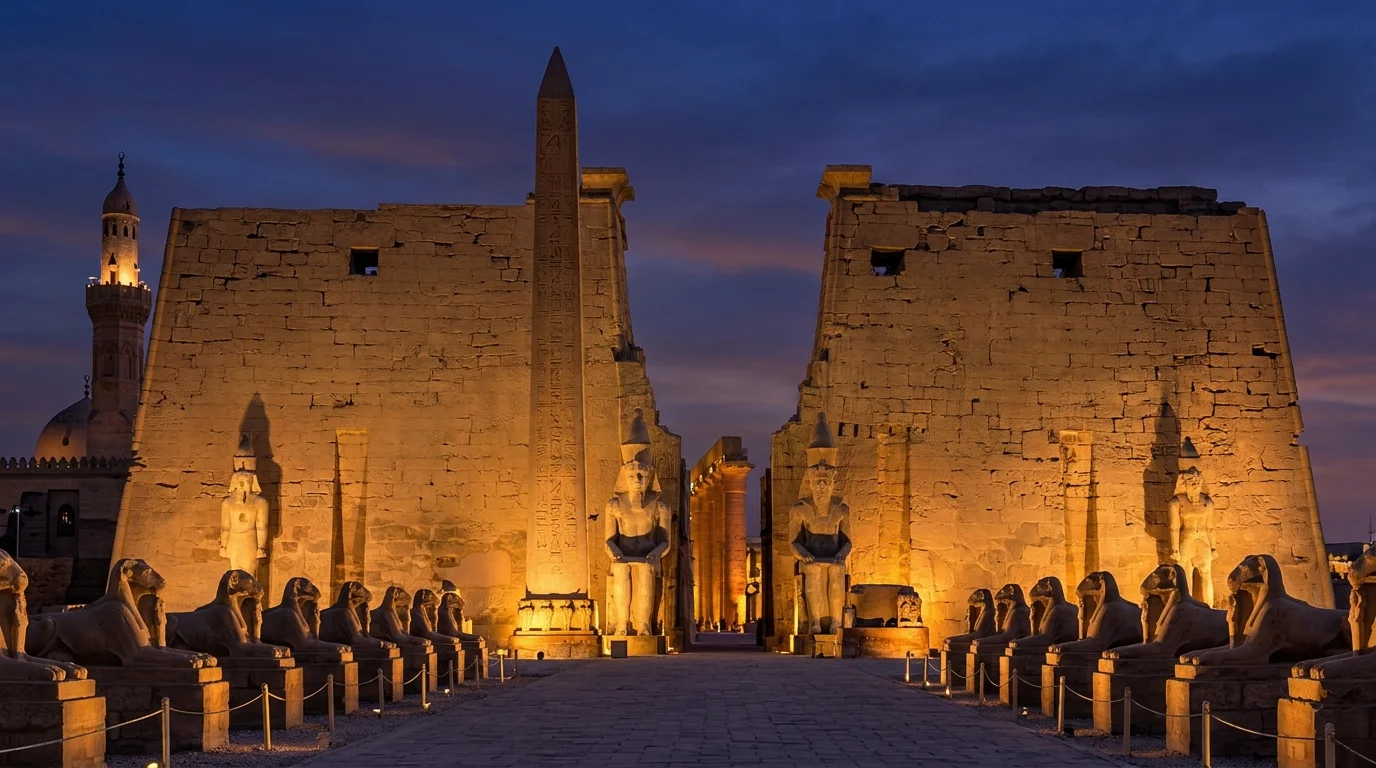
Most of Egypt’s great temples sit at the edge of the desert, but Luxor Temple stands in the middle of a living city. Its colossal statues and columns rise beside the Nile corniche, a short walk from hotels, cafés and the souk, and after dark the whole temple is lit up in warm gold. It is also one of the few places in Egypt where you can see more than 3,000 years of history in a single building, from pharaonic reliefs to Roman wall paintings and a mosque that still holds daily prayers.
This guide explains the history of Luxor Temple, what to see in walking order, the later layers that make it unique, and how to plan your visit, including why many travelers prefer to go at night.
Luxor Temple at a Glance
The temple was the southern partner of Karnak, linked to it by the Avenue of Sphinxes, and it played a key role in ancient religious festivals and in the idea of divine kingship.
| What to know | Details (verify before travel) |
|---|---|
| Location | Centre of Luxor’s East Bank, beside the Nile corniche |
| Built mainly by | Amenhotep III, with major additions by Ramesses II |
| Dedicated to | Amun, Mut and Khonsu, and the divine kingship of the pharaoh |
| Highlights | Obelisk, Ramesses II statues, colonnade, sun court, Roman frescoes |
| Time needed | About one to two hours |
The History of Luxor Temple
Luxor Temple was built and rebuilt over many centuries, and each period left its mark.
Amenhotep III’s Temple
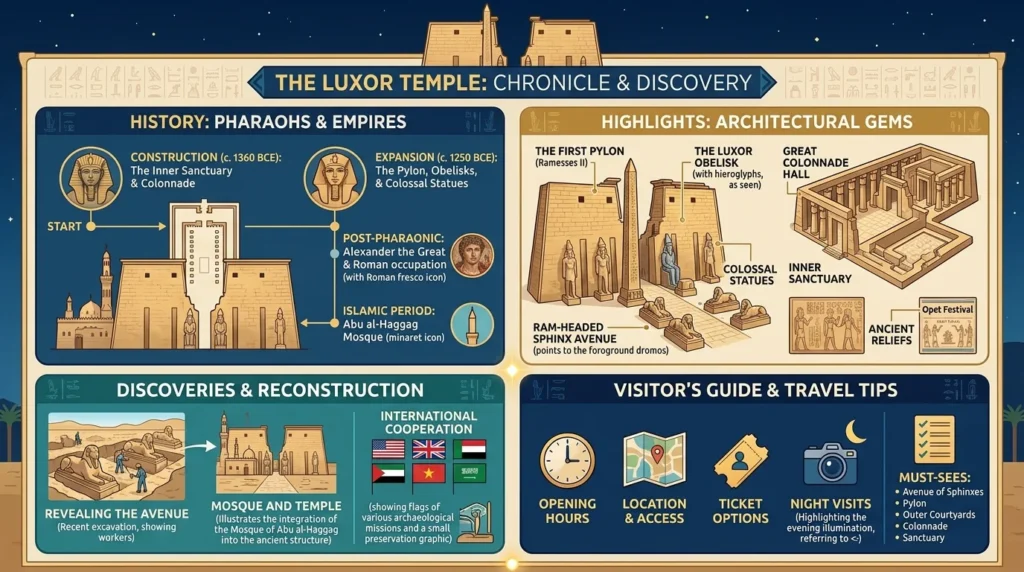
Most of the temple you see today was built by Amenhotep III around 1400 BC, including the great colonnade and the elegant sun court. Unlike many temples, it was not dedicated mainly to a single god in the usual way. It was closely linked to the idea of the royal ka, the divine spirit of kingship, which each pharaoh was believed to receive. Some scholars think kings came here to have their divine power renewed.
Ramesses II Makes His Mark
About a century later, Ramesses II added the massive entrance pylon, two obelisks, colossal statues of himself and a large courtyard. His additions turned the front of Luxor Temple into a grand statement of royal power, and they are what most visitors see first.
The Opet Festival
Each year, during the Opet Festival, statues of Amun, Mut and Khonsu were carried in sacred boats from Karnak to Luxor Temple, either along the Avenue of Sphinxes or by river. The festival lasted for days and celebrated the renewal of the king’s divine authority. Reliefs in the colonnade show the procession in lively detail.
Alexander the Great and the Romans
Later rulers also used the temple. Alexander the Great rebuilt the barque shrine at its heart in his own name. Under the Roman emperor Diocletian, at the end of the 3rd century AD, part of the temple became a military camp, and one of its halls was converted into a chamber for the imperial cult.
How Luxor Got Its Name?
The Roman camp built around the temple may even have given the modern city its name. Luxor comes from the Arabic al-Uqsur, usually translated as “the palaces” and widely thought to derive from the Latin castra, meaning a fortified camp. If so, the name of the whole city traces back to the soldiers stationed at Luxor Temple.
What to See at Luxor Temple, in Walking Order?
The temple runs roughly north to south, so a visit starts at the Avenue of Sphinxes and moves deeper into the building.
The Avenue of Sphinxes
The processional avenue that once linked Luxor Temple with Karnak, about 2.7 km away, is lined with human-headed sphinxes near the temple entrance. It was reopened in 2021 after decades of excavation. Standing at its southern end gives you the same approach that ancient processions took.
The Pylon and the Obelisk
The entrance pylon of Ramesses II is carved with scenes of his battles, including the Battle of Kadesh. In front stands a single obelisk, about 25 metres tall. Its twin was given to France in the 19th century and has stood in the Place de la Concorde in Paris since 1836. Seated and standing colossi of Ramesses II flank the gateway. On the bases of the seated statues, look for carved Nile gods tying together the plants of Upper and Lower Egypt, a symbol of a united country.
The Court of Ramesses II
Beyond the pylon, the open Court of Ramesses II is surrounded by a double row of papyrus columns, with standing statues of the king between them. Some of these statues were originally carved for earlier kings and later reinscribed with his name. In one corner, the Mosque of Abu Haggag sits high above the ancient floor, a striking reminder of how the temple was once buried.
The Colonnade of Amenhotep III
Next comes the processional colonnade, a corridor of 14 huge papyrus columns, each around 19 metres tall. The walls carry reliefs of the Opet Festival completed under Tutankhamun and Horemheb, showing musicians, dancers, priests and boats. It is one of the most impressive spaces in Luxor Temple, and the late-afternoon light brings out the carvings best.
The Sun Court
The colonnade leads into the sun court of Amenhotep III, surrounded by elegant columns. In 1989, a cache of beautifully preserved statues was discovered buried beneath its floor; many are now displayed in the Luxor Museum. They had been carefully buried by priests in antiquity, probably to protect them, and their discovery was one of the most important finds in Luxor in the late 20th century.
The Inner Sanctuary
Deeper inside, a series of halls and chapels leads to the barque shrine rebuilt by Alexander the Great, carved with scenes showing him as a pharaoh making offerings to Amun. Nearby rooms include the so-called birth room, with scenes of Amenhotep III’s divine birth.
Layers of Later History
What makes Luxor Temple so special is that people never really stopped using it.
Roman Wall Paintings
In the late 3rd century AD, Roman builders converted one of the inner halls into an imperial cult chamber, plastering over the pharaonic reliefs and painting them with frescoes of emperors and officials. Between 2005 and 2008, the American Research Center in Egypt cleaned and conserved these rare paintings, as described in ARCE’s project archive. Today you can see Roman paint and Egyptian carving side by side.
Christian Traces
In late antiquity, churches were built in and around the temple. Traces of Christian use survive in places, including crosses and remains of church structures. Look near the outer walls and the area in front of the temple, where the foundations of several churches have been exposed, and you can see how the site shifted from pharaonic to Christian use over a few centuries.
The Mosque of Abu Haggag
In the 13th century, a mosque dedicated to the Sufi saint Abu Haggag was built on top of the temple, which was then buried under sand and later buildings. When archaeologists cleared the temple, they left the mosque in place, so its doorway now sits high above the ancient floor. It is still an active mosque, which makes Luxor Temple a place of worship for more than 3,000 years.
Visiting Luxor Temple
A few practical points will help you plan.
Day or Night?
Luxor Temple is open from early morning until late in the evening, with sources currently listing about 6:00 to 22:00. Many visitors prefer the evening, when the temple is floodlit, the air is cooler and the atmosphere is magical. Morning visits are quieter and better for reading the reliefs. If you can, go just before sunset and stay as the lights come on.
Tickets
Prices are revised periodically, so check Egypt’s official EgyMonuments site before you go.
Combining with Karnak
Karnak and Luxor Temple are about 3 km apart, so they combine easily in one day: Karnak in the morning and Luxor Temple in the evening is a classic plan.
Guides
A licensed Egyptologist guide can explain the Opet reliefs, the Roman chamber and the different building phases, which are easy to miss without context.
What to Bring?
Wear comfortable shoes and bring water. In the daytime, a hat and sunscreen are essential, while in winter evenings a light layer is useful. Dress respectfully near the mosque.
Accessibility
Most of Luxor Temple is on one level, with wide paths and paved areas, so it is easier to explore than many sites in Egypt. Some surfaces are uneven, and there are a few steps between areas, so visitors with limited mobility may want help in places. Evening visits are also gentler in hot weather.
Visiting from Hurghada
Luxor is about four hours by road from Hurghada. Day trips from the Red Sea usually focus on Karnak and the West Bank, so if seeing Luxor Temple matters to you, ask whether it is included or consider staying overnight in Luxor.
Three Example Visit Plans
These examples show different ways to visit Luxor Temple. They are illustrations, not fixed tours.
The classic East Bank day. A couple visits Karnak in the morning, rests at midday and walks to Luxor Temple just before sunset, staying until the lights come on.
The quiet morning. A history enthusiast arrives at opening to study the colonnade reliefs and the Roman frescoes in peace, then visits the Luxor Museum to see the statues from the sun court cache.
The night after a cruise. Travelers on a Nile cruise spend their final evening in Luxor at the temple, often a short walk or ride from the ship.
Frequently Asked Questions
Most of it was built by Amenhotep III around 1400 BC. Ramesses II added the entrance pylon, obelisks, colossal statues and a large courtyard about a century later.
Many visitors think so. The temple is floodlit in the evening, it is cooler and the atmosphere is special. Morning is better for studying the reliefs.
About one to two hours is enough for most visitors.
It has stood in the Place de la Concorde in Paris since 1836.
Yes. The Mosque of Abu Haggag was built on top of the buried temple in the 13th century and is still in use today.
Plan Your Visit to Luxor Temple
Luxor Temple brings together pharaohs, Roman emperors and a living mosque in the heart of a modern city. See it as the light fades, look closely at the layers of history, and it may become your favorite moment in Luxor.
When you are ready, explore our Luxor tours, including private Luxor tours, see our Nile cruise options, or contact Lovely Egypt Tours to plan your visit.