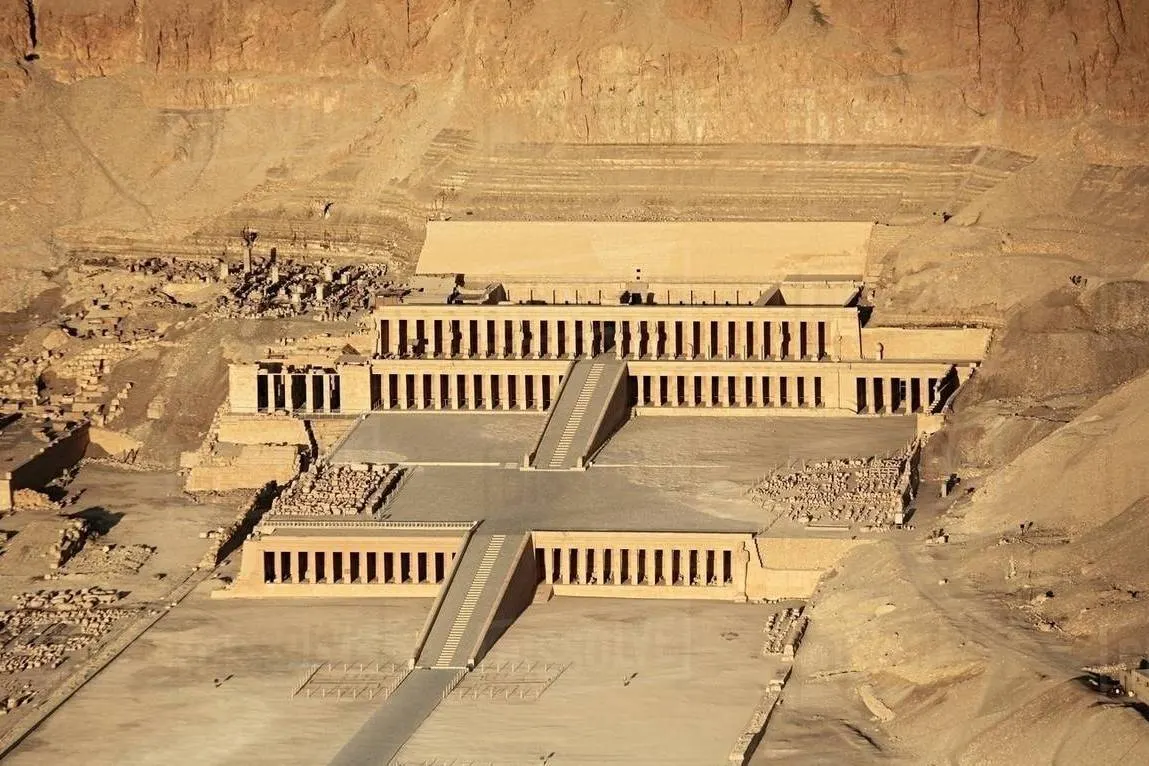
Set against a wall of golden limestone cliffs on Luxor’s West Bank, the Temple of Hatshepsut looks unlike any other building in Egypt. Its long, clean colonnades rise in three broad terraces, and from a distance it can almost look modern. It was built 3,500 years ago for one of the most remarkable rulers in ancient history: a woman who took the throne and ruled Egypt as pharaoh.
This guide tells the story of Hatshepsut and her temple, walks you through it terrace by terrace, explains how it was rescued and restored, and gives practical advice for visiting from Luxor or on a day trip from Hurghada.
Temple of Hatshepsut at a Glance
The temple stands at Deir el-Bahari, a natural bay in the cliffs opposite Karnak, just over the mountain from the Valley of the Kings. Ancient Egyptians called it Djeser-Djeseru, usually translated as “Holy of Holies.”
| What to know | Details (verify before travel) |
|---|---|
| Location | Deir el-Bahari, West Bank of Luxor |
| Built for | Hatshepsut, who ruled about 1479 to 1458 BC |
| Type | Mortuary temple, also dedicated to Amun-Ra, Hathor and Anubis |
| Highlights | Punt reliefs, Birth Colonnade, Hathor and Anubis chapels, Upper Terrace |
| Time needed | About one hour; longer for a detailed visit |
Hatshepsut: The Woman Who Ruled as Pharaoh
To understand the Temple of Hatshepsut, you need to know the remarkable woman behind it.
From Queen to King
Hatshepsut was the daughter of Thutmose I and the wife of her half-brother Thutmose II. When he died, the heir, the young Thutmose III, was a child, and Hatshepsut acted as regent. Within a few years, she went further and was crowned king. She ruled for around two decades, a period remembered for stability, trade and ambitious building projects. In official art, she was often shown with the traditional false beard and regalia of a male pharaoh.
Senenmut, the Royal Steward
Many of Hatshepsut’s projects are linked to Senenmut, her powerful steward and official. He is traditionally credited with overseeing the design of the Temple of Hatshepsut, and small images of him appear in hidden places within the temple, a privilege rarely given to someone who was not royal.
Erased from History
After Hatshepsut’s death, Thutmose III ruled alone for many years. Late in his reign, her images and names were systematically removed from monuments, including much of the Temple of Hatshepsut. Statues were smashed and dumped in nearby quarries, and some reliefs were recarved with the names of other kings. Scholars still debate the motive, but it may have been about securing the royal succession rather than personal revenge.
Her Tomb and Mummy
Hatshepsut was buried in the Valley of the Kings, on the far side of the cliff behind her temple, and the Temple of Hatshepsut lies almost directly opposite it, on the other side of the same mountain, so that the two were linked in the landscape. Her mummy was not identified until 2007, when researchers linked a mummy found in a smaller tomb to a box bearing her name that contained a tooth. Her mummy is now displayed in the Royal Mummies Hall of the National Museum of Egyptian Civilization in Cairo.
The Temple of Hatshepsut, Terrace by Terrace
The temple’s design leads visitors upward through three terraces linked by long ramps, from the valley floor toward the cliff face.
The Lower Terrace
The first terrace was once fronted by gardens with trees planted in pits, possibly including incense trees brought from distant lands. Behind the lower colonnade, reliefs show the transport of obelisks from Aswan to Karnak by barge. The lower level of the Temple of Hatshepsut sets the scene for the stories told higher up.
The Punt Colonnade
On the middle terrace, the left-hand colonnade holds the most famous reliefs in the Temple of Hatshepsut: the expedition to the Land of Punt. They show ships sailing down the Red Sea, houses on stilts, the ruler of Punt and his queen, and Egyptians returning with myrrh trees, ebony, gold and exotic animals. The location of Punt is still debated, though many scholars place it somewhere along the southern Red Sea coast of Africa.
The Birth Colonnade
On the right-hand side of the middle terrace, the Birth Colonnade tells the story of Hatshepsut’s divine conception and birth. The god Amun is shown visiting her mother, Queen Ahmose, and the ram-headed god Khnum shapes the child on his potter’s wheel. These scenes were political as well as religious: they presented Hatshepsut as the true daughter of Amun and therefore a legitimate ruler. They are among the most important political images anywhere in the Temple of Hatshepsut.
The Chapel of Hathor
At the southern end of the middle terrace, the Chapel of Hathor is dedicated to the cow-headed goddess of love and music, a protector of the Theban mountain. Its columns are topped with the face of Hathor, and inside you can see images of Hatshepsut being suckled by the goddess as a cow. Look for small images of Senenmut tucked behind doors here, one of the most intriguing details in the Temple of Hatshepsut.
The Chapel of Anubis
At the northern end, the Chapel of Anubis has some of the best-preserved color in the Temple of Hatshepsut, with deep blues and reds still vivid on the walls and ceiling decorated with stars.
The Upper Terrace and the Sanctuary of Amun
The Upper Terrace is lined with large Osiride statues of Hatshepsut, showing her in the form of Osiris, god of the afterlife. Behind them, a granite gateway leads into a festival court and, carved into the cliff itself, the Sanctuary of Amun-Ra. The terrace also contains a solar cult complex with an open-air altar to the sun, and chapels for the royal cult.
Rediscovery and Restoration
For centuries after antiquity, the Temple of Hatshepsut lay in ruins.
A Coptic Monastery
Rockfalls and earthquakes damaged the colonnades, and in the Coptic period a monastery was built on the upper terrace. The site’s modern name, Deir el-Bahari, means “Northern Monastery” and comes from this later use.
Excavation and Reconstruction
Excavations from the 19th century onward cleared the debris and recovered thousands of fragments. Since 1961, the Polish-Egyptian Archaeological and Conservation Expedition, founded by Kazimierz Michałowski of the University of Warsaw, has worked to reconstruct the upper terraces. Its team reopened the Solar Cult Complex in 2015 and the Main Sanctuary of Amun-Ra in 2017, according to the Polish Centre of Mediterranean Archaeology. Much of what you see today on the Upper Terrace of the Temple of Hatshepsut is the result of that careful work.
Mentuhotep II’s Temple Next Door
Just south of Hatshepsut’s temple lie the ruins of the mortuary temple of Mentuhotep II, built around 500 years earlier. Its terraced design almost certainly inspired Hatshepsut’s architects, and you can see the remains from the lower terrace.
Visiting the Temple of Hatshepsut
A few practical points will help you enjoy your visit.
Tickets and Opening Hours
The site generally opens at 6:00 and closes at 17:00, according to Kupi’s visitor guide, though hours can change with season and during Ramadan. Prices are revised periodically, so check Egypt’s official EgyMonuments site before you go.
Getting Around the Site
From the visitor centre, a small electric train or cart usually carries visitors toward the temple for a small fee, or you can walk. From there, wide ramps lead up through the terraces. The climb is gentle, but the site is exposed and very hot by late morning.
When to Go
The best time to visit the Temple of Hatshepsut is early morning, when the cliffs glow in soft light and the heat is manageable. Late afternoon is also good. From October to April, temperatures are comfortable for a longer visit. At dawn, hot-air balloons often drift over Deir el-Bahari, giving a spectacular view of the temple from above.
Guides
A licensed Egyptologist guide can explain the Punt and Birth reliefs, point out Senenmut’s hidden images and help you spot where Hatshepsut’s figures were erased. Without that context, much of the meaning of the Temple of Hatshepsut is easy to miss.
What to Bring?
Bring a hat, sunscreen, sunglasses and water, and wear comfortable shoes for the ramps. There is very little shade outside the colonnades, so plan your visit around the heat. A small pair of binoculars or a phone zoom helps you study the higher reliefs, and a light scarf offers extra protection from the sun on the open ramps between terraces.
Visiting from Hurghada
Luxor is about four hours by road from Hurghada, and full-day trips from the Red Sea usually include the Temple of Hatshepsut together with the Valley of the Kings, the Colossi of Memnon and Karnak.
Three Example Visit Plans
These examples show different ways to visit the Temple of Hatshepsut. They are illustrations, not fixed tours.
The early West Bank morning. A couple visits the Valley of the Kings at opening, then the Temple of Hatshepsut before the heat builds, stopping at the Colossi of Memnon on the way back.
The balloon and temple day. A traveler takes a sunrise balloon flight over the West Bank, then visits the temple on foot after landing.
The day trip from Hurghada. A family on a Red Sea holiday joins a Luxor day trip covering Karnak, the Valley of the Kings and the Temple of Hatshepsut, returning to their hotel in the evening.
Frequently Asked Questions
It was built for Hatshepsut, who ruled Egypt as pharaoh around 1479 to 1458 BC. Her steward Senenmut is traditionally credited with overseeing its design.
Its unique terraced design against the cliffs, the reliefs of the expedition to Punt, the Birth Colonnade and the well-preserved Chapel of Anubis.
About an hour is enough for most visitors. Allow longer if you want to study the reliefs in detail.
After her death, her successor Thutmose III had many of her images and names removed late in his reign. Scholars debate the reason, but it may have been about securing the royal line.
Yes. Full-day trips from Hurghada usually combine it with the Valley of the Kings, the Colossi of Memnon and Karnak.
Plan Your Visit to the Temple of Hatshepsut
The Temple of Hatshepsut tells the story of a woman who claimed the highest power in Egypt, of a successor who tried to erase her, and of the modern teams who put her temple back together. Go early, look closely at the reliefs, and the story comes alive.
When you are ready, explore our Luxor tours, including day trips from Hurghada and private Luxor tours, or contact Lovely Egypt Tours to plan your visit.