Walking into the Great Hypostyle Hall at Karnak Temple is one of those moments that stays with you. Giant stone columns rise around you like a petrified forest, their surfaces covered in carvings that were once brightly painted. And this is only one part of a complex that ancient Egyptians kept building, rebuilding and expanding for around 2,000 years.
This guide explains the history of Karnak Temple, what to see in a logical walking order, how to read the reliefs, and how to plan your visit from Luxor or as part of a day trip from Hurghada.
Karnak Temple at a Glance
Karnak is not a single temple but a vast religious complex on the East Bank of Luxor, the ancient city of Thebes. Its heart is the Precinct of Amun-Ra, the part most visitors explore, with smaller precincts dedicated to the goddess Mut and the war god Montu nearby.
| What to know | Details (verify before travel) |
|---|---|
| Location | Northern edge of Luxor’s East Bank, about 3 km from Luxor Temple |
| Dedicated to | Amun-Ra, with his consort Mut and son Khonsu |
| Built | From the Middle Kingdom to the Ptolemaic period, around 2,000 years |
| Highlights | Great Hypostyle Hall, obelisks, sacred lake, Open Air Museum |
| Time needed | Two to three hours; longer with the Open Air Museum |
The History of Karnak Temple
To appreciate Karnak Temple, it helps to understand why it grew so large.
The Home of Amun-Ra
Ancient Egyptians called Karnak Ipet-Isut, often translated as “the most select of places.” It was the main cult center of Amun, a local Theban god who rose to become Amun-Ra, king of the gods, when Theban rulers reunited Egypt. As Thebes became the religious capital of the New Kingdom, Karnak Temple became the richest and most powerful temple in the country, with vast estates, workshops and thousands of staff.
Two Thousand Years of Building
Building began in the Middle Kingdom, and almost every pharaoh who followed wanted to leave his mark. Kings added pylons, courtyards, chapels, obelisks and statues, often reusing blocks from earlier structures. Hatshepsut, Thutmose III, Seti I, Ramesses II and many others contributed, and construction continued into the Ptolemaic period. That long history is why Karnak Temple can feel like a maze: you are walking through layers of different reigns.
The Opet Festival
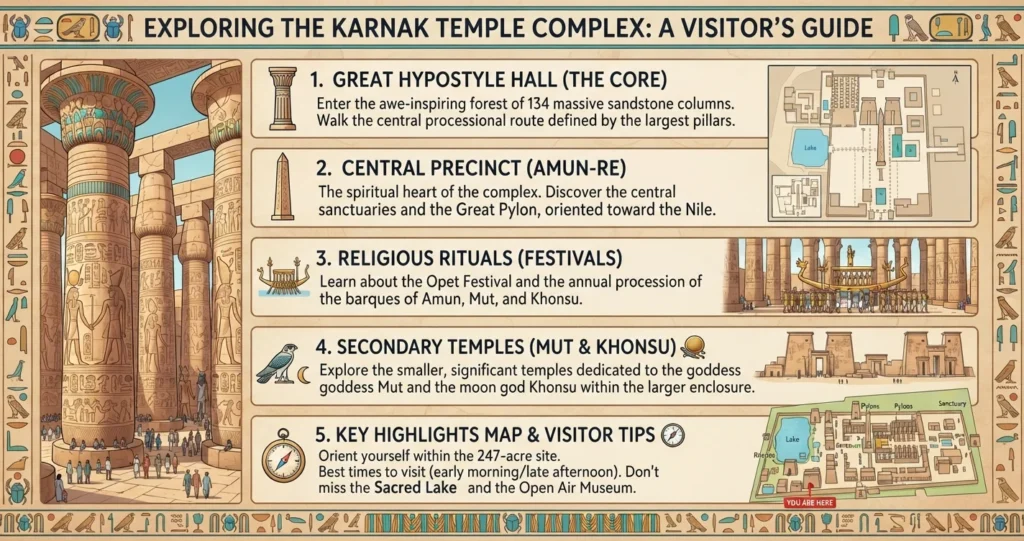
Each year, during the Opet Festival, statues of Amun, Mut and Khonsu were carried in sacred boats from Karnak Temple to Luxor Temple along the Avenue of Sphinxes, or by river. The celebration renewed the king’s divine power and drew huge crowds. Walking part of the restored avenue today helps you picture these processions.
A World Heritage Site
Karnak is part of the UNESCO World Heritage Site of Ancient Thebes with its Necropolis, listed in 1979 alongside Luxor Temple and the monuments of the West Bank. Restoration and excavation continue, and new finds are still made in and around Karnak Temple.
What to See at Karnak Temple, in Walking Order?
The best way to explore Karnak Temple is to follow the main east–west axis from the entrance toward the inner sanctuary, then branch off to the side features.
The Avenue of Ram-Headed Sphinxes
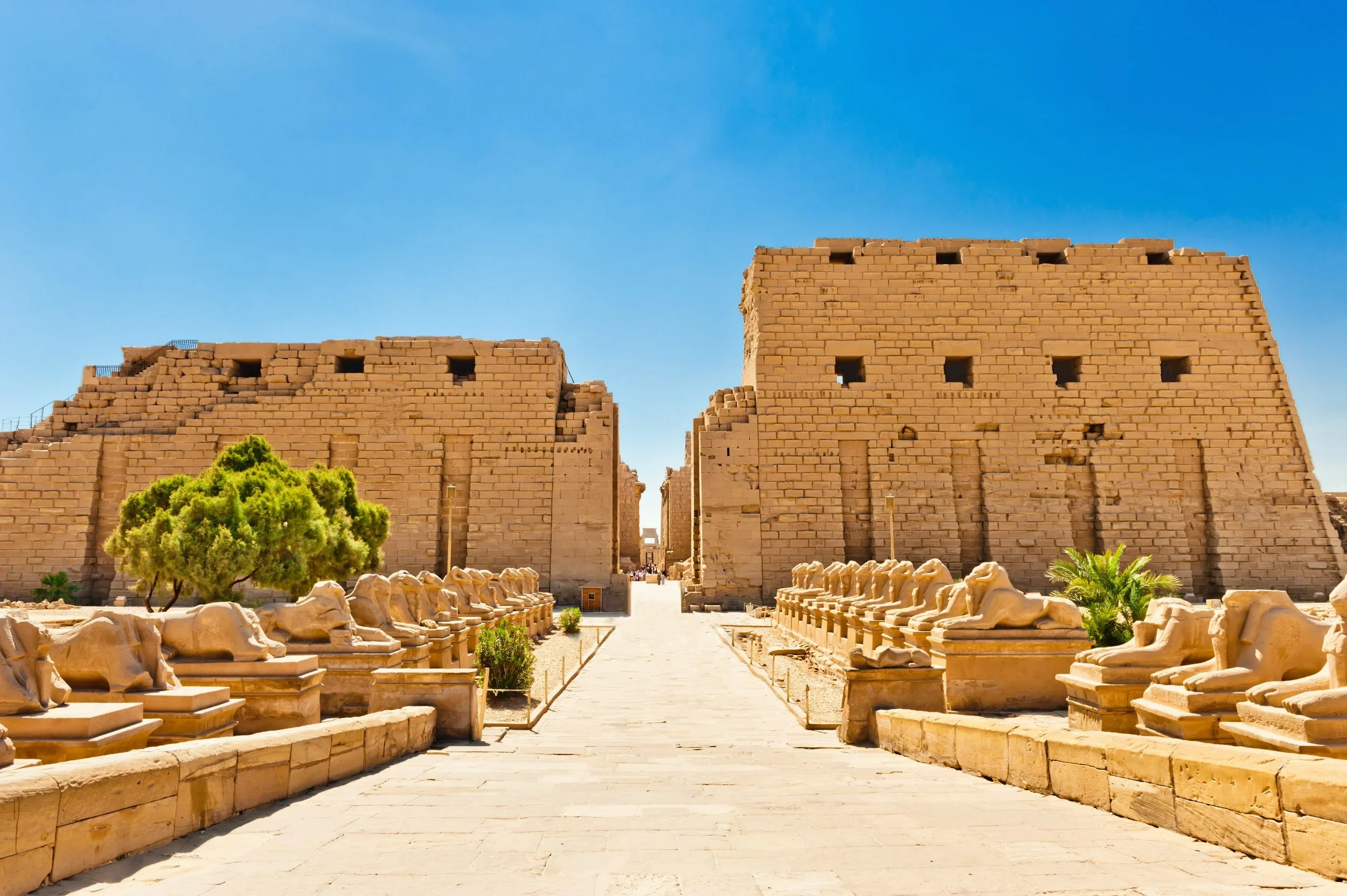
Your visit starts at the river-facing entrance, lined with ram-headed sphinxes. The ram was a symbol of Amun, and small statues of the king stand protected between the rams’ front legs. The avenue once linked the temple to a quay on the Nile, where sacred boats arrived during festivals, so this is where ancient visitors would also have begun.
The First Pylon
The massive First Pylon is the main gateway. It was never finished; on its inner side you can still see the remains of mudbrick construction ramps, a rare clue to how the Egyptians built such structures.
The Great Court
Beyond the pylon, the Great Court contains the remains of a kiosk built by the Kushite king Taharqa, a shrine of Seti II and a small temple of Ramesses III. One giant standing column of Taharqa’s kiosk survives. Look also for the colossal statue near the entrance to the Hypostyle Hall, usually attributed to Ramesses II and later reinscribed by another ruler, a common practice at Karnak.
The Great Hypostyle Hall
The highlight of Karnak Temple is the Great Hypostyle Hall, a forest of 134 sandstone columns covering an area larger than many cathedrals. The twelve central columns are around 21 metres tall, with open papyrus capitals, while the shorter columns on either side have closed papyrus-bud capitals. The hall was built mainly under Seti I and Ramesses II, and traces of the original paint survive high on the columns and architraves. Take time here; it is the part of Karnak Temple most visitors remember.
The Obelisks
Further in, the obelisk of Hatshepsut, about 30 metres tall, is the tallest still standing in Egypt, carved from a single piece of Aswan granite. Nearby stands an obelisk of her father, Thutmose I. Hatshepsut’s successor, Thutmose III, later walled her obelisks in, which helped preserve them.
The Sanctuary and Festival Hall
The sanctuary of the sacred boat, rebuilt in the name of Philip Arrhidaeus, half-brother of Alexander the Great, stands at the heart of the temple. Beyond it lies the Festival Hall of Thutmose III, with unusual columns that imitate tent poles and a room carved with plants and animals the king saw on campaign, often called the Botanical Garden. The hall was used for rituals that celebrated and renewed the king’s power.
The Sacred Lake and the Giant Scarab
To the south lies the Sacred Lake, where priests purified themselves before rituals. Their houses and storerooms once stood around its edges. Beside it, a large granite scarab dedicated by Amenhotep III is a popular stop; visitors often walk around it for luck. It is a pleasant place to pause in the middle of a long walk through Karnak Temple.
The Open Air Museum
On the north side, the Open Air Museum displays reconstructed chapels, including the elegant White Chapel of Senusret I and the Red Chapel of Hatshepsut, rebuilt from blocks found inside later pylons. It usually needs a separate ticket and is quieter than the main temple.
How to Read Karnak Temple?
The walls and columns of Karnak Temple are packed with meaning.
Kings and Gods
Most reliefs show the king making offerings to the gods, or the gods granting him life, power and victory in return. This exchange was the core idea of Egyptian temple religion: the king maintained cosmic order, and the gods kept Egypt safe.
Battle Scenes
On the outer walls of the Hypostyle Hall, carved battle scenes record campaigns of Seti I and Ramesses II. They were political statements as much as history, showing the king as the defender of Egypt.
Symbolism in Stone
The temple was designed as a model of creation. Floors rise and ceilings drop as you move toward the sanctuary, and the columns represent papyrus plants growing from the primeval marsh. The deeper you walk into Karnak Temple, the closer you come to the god.
Visiting Karnak Temple
A few practical points make a visit more comfortable.
Tickets and Opening Hours
The temple opens early in the morning and closes in the late afternoon; ticket sellers commonly list hours of about 6:00 to 17:30, though these can change with season and during Ramadan. The Open Air Museum has its own ticket. Prices are revised periodically, so check Egypt’s official EgyMonuments site before you go.
When to Visit?
Karnak Temple is large and open to the sun, so arrive at opening time or come in the late afternoon. From October to April, temperatures are comfortable for a longer visit. On the winter solstice, around 21 December, the rising sun aligns with the temple’s main axis, an event that draws visitors to watch the sunrise.
Guides
A licensed Egyptologist guide makes a huge difference at Karnak, where the layers of construction are confusing without context. A guide can point out details such as the construction ramp, the paint traces and the king lists.
What to Bring?
Wear comfortable shoes, because the walk through Karnak Temple covers uneven ground and can easily exceed two kilometres. Bring a hat, sunscreen, sunglasses and water, and a card or cash for tickets. Shade is limited outside the Hypostyle Hall, so plan short breaks.
The Sound and Light Show
In the evening, a sound and light show brings Karnak Temple to life with lighting, narration and music as you walk through parts of the complex. Shows run in several languages on different nights, so check the schedule for your preferred language before booking.
Visiting from Hurghada
Luxor is about four hours by road from Hurghada, and full-day trips from the Red Sea usually include Karnak Temple together with the Valley of the Kings and the Temple of Hatshepsut. It is a long day, but Karnak is often the moment that makes it worthwhile.
Three Example Visit Plans
These examples show different ways to explore Karnak Temple. They are illustrations, not fixed tours.
The classic morning. A couple arrives at opening with a guide, walks the main axis from the ram-headed sphinxes to the Festival Hall, pauses at the Sacred Lake and finishes by mid-morning.
The deep dive. A history enthusiast spends half a day, including the Open Air Museum, then returns at night for the sound and light show.
The day trip from Hurghada. A family on a Red Sea holiday visits Karnak Temple in the morning as part of a Luxor day trip, then crosses to the West Bank for the Valley of the Kings.
Frequently Asked Questions
Construction began in the Middle Kingdom, around 4,000 years ago, and continued for roughly 2,000 years into the Ptolemaic period.
Two to three hours covers the main axis and highlights. Allow extra time for the Open Air Museum or a slower visit.
It is a huge hall of 134 sandstone columns, built mainly under Seti I and Ramesses II, and the most famous part of Karnak.
For many visitors, yes. It shows the temple in a different atmosphere and adds historical narration. Check which language is scheduled on your evening.
Yes. Full-day trips from Hurghada usually combine Karnak with the Valley of the Kings and the Temple of Hatshepsut.
Plan Your Visit to Karnak Temple
Karnak Temple is the place where ancient Egypt’s ambition is easiest to feel. Walk the main axis slowly, look up in the Hypostyle Hall, and let a guide explain the layers of history around you.
When you are ready, explore our Luxor tours, including day trips from Hurghada and private Luxor tours, or contact Lovely Egypt Tours to plan your visit.