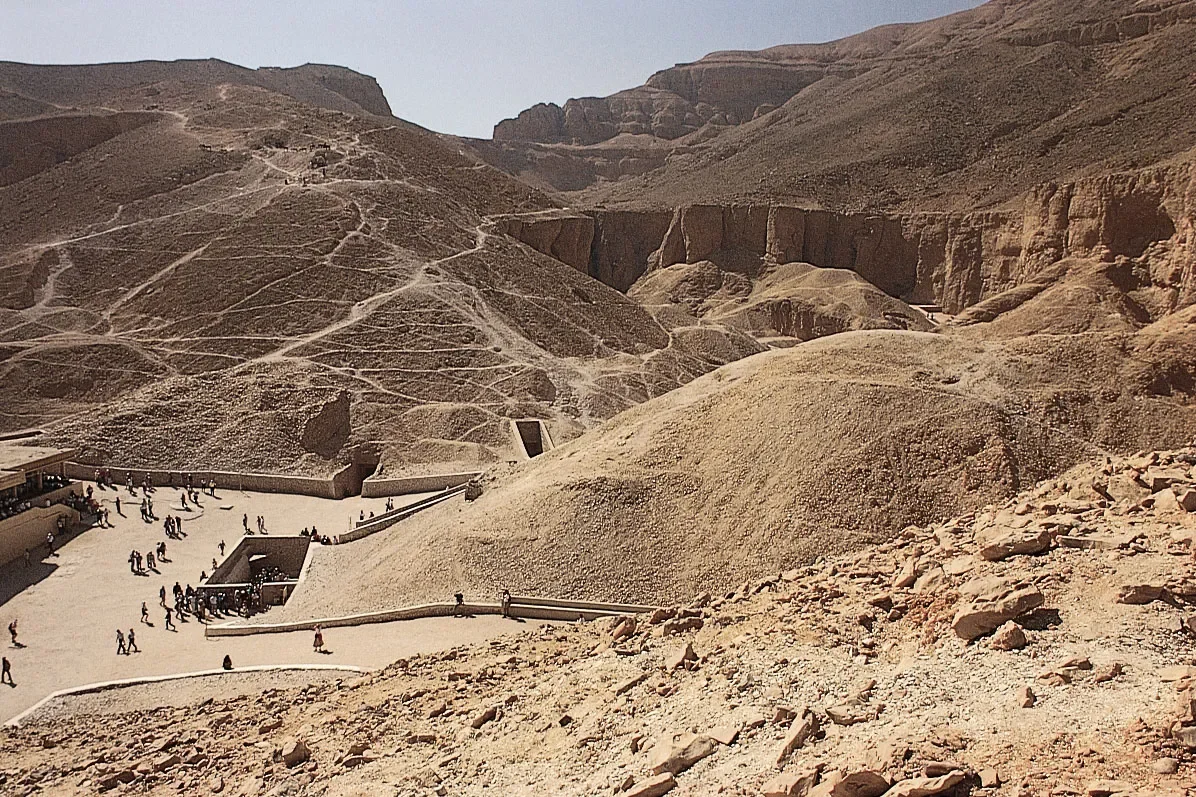
For nearly 500 years, the pharaohs of Egypt’s New Kingdom were buried in a dry, rocky valley on Luxor’s West Bank. Today the Valley of the Kings is one of the most famous archaeological sites in the world, home to Tutankhamun’s tomb and dozens of others whose painted corridors still glow with color more than 3,000 years after they were sealed.
This guide covers the history of the Valley of the Kings, what the tomb paintings mean, which tombs are open and worth choosing, and how to plan your visit from Luxor or as a day trip from Hurghada.
Valley of the Kings at a Glance
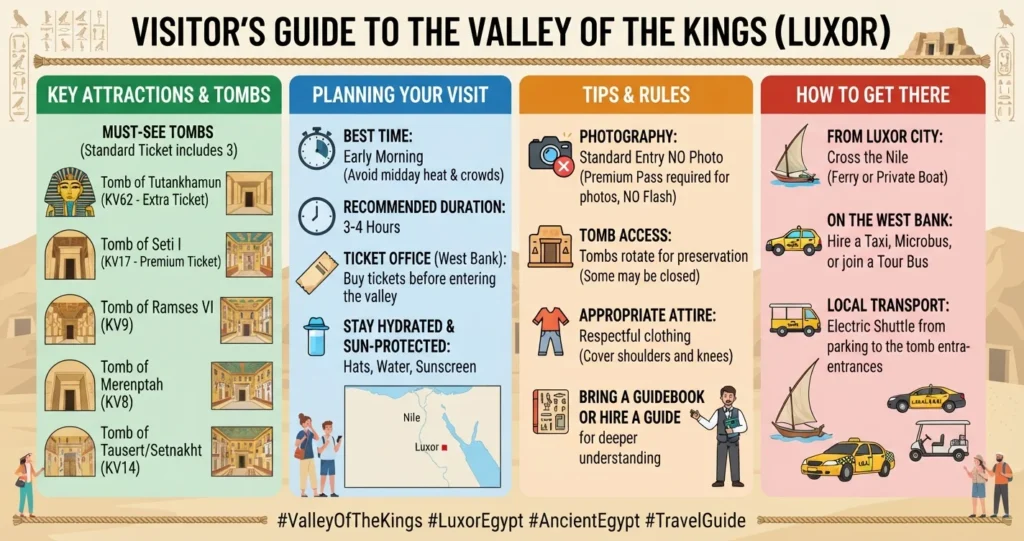
The valley holds more than 60 known tombs, numbered from KV1 upward in order of discovery. Only a rotating selection is open at any time. The standard ticket covers three tombs from a list of about ten, while the tombs of Tutankhamun, Seti I and Ramesses V and VI each need an extra ticket.
| What to know | Details (verify before travel) |
|---|---|
| Location | West Bank of Luxor, about 30–40 minutes by road from the East Bank hotels |
| Period | New Kingdom, roughly 1539 to 1075 BC |
| Standard ticket | Choose three tombs from the open list |
| Extra tickets | Tutankhamun (KV62), Seti I (KV17), Ramesses V and VI (KV9) |
| Time needed | Two to three hours |
The History of the Valley of the Kings
To appreciate the Valley of the Kings, it helps to know why the pharaohs chose it and what happened to their tombs.
Why the Pharaohs Moved Here?
Old Kingdom rulers built pyramids, but these were obvious targets for robbers. When Thebes became the capital in the New Kingdom, kings chose a different approach: hidden tombs cut deep into the cliffs of the West Bank. The valley lies beneath a natural pyramid-shaped peak, el-Qurn, which may have added to its appeal. Thutmose I is usually credited as one of the first kings buried in the Valley of the Kings, and royal burials continued until the end of the 20th Dynasty.
The Craftsmen of Deir el-Medina
The tombs were cut and decorated by a specialist community of quarrymen, plasterers, scribes and painters who lived in the village now called Deir el-Medina, over the hill from the valley. Their work was organized in shifts, and their own records, including notes on absences and supplies, survive on pottery shards and limestone flakes. Some of these records even document what may be the earliest known labor strike, during the reign of Ramesses III.
Robbers and Royal Caches
Despite the secrecy, almost every tomb in the Valley of the Kings was robbed in antiquity. By the end of the New Kingdom, priests gathered many royal mummies and reburied them in hidden caches to protect them. One cache near Deir el-Bahari, found in the late 19th century, contained dozens of royal mummies, including Ramesses II. These mummies are now displayed at the National Museum of Egyptian Civilization in Cairo.
Howard Carter and Tutankhamun
In November 1922, Howard Carter, working for Lord Carnarvon, found the entrance to an almost intact royal tomb: KV62, the tomb of Tutankhamun. Its thousands of objects, including the famous gold mask, made it the most celebrated archaeological discovery of the 20th century. Tutankhamun’s tomb is small, probably because the young king died unexpectedly, but it remains the most famous in the Valley of the Kings. His treasures are now displayed at the Grand Egyptian Museum near Giza.
What the Tomb Paintings Mean?
The walls of the Valley of the Kings are not decoration for its own sake. They are religious texts meant to guide the king through the underworld to rebirth.
The Journey of the Sun
Many tombs show the sun god’s nightly voyage through the twelve hours of the night, during which he battles chaos and is reborn at dawn. The king hoped to join that journey and rise again with the sun. Texts such as the Amduat, the Book of Gates and the Book of Caverns describe the stages of the voyage in detail, with gods, demons and gates the king had to pass.
Reading the Walls
Look for the king standing before gods such as Osiris, Anubis and Ra-Horakhty, rows of hieroglyphs running down long corridors, and astronomical ceilings showing the sky goddess Nut swallowing and giving birth to the sun. A guide can explain the scenes before you enter, because guides are not permitted to talk inside the tombs.
The Best Tombs in the Valley of the Kings
Choosing your three tombs is the main decision of a visit to the Valley of the Kings. The open list changes periodically, so check on the day.
Tombs on the Standard Ticket
According to Earth Trekkers’ July 2026 update, the tombs currently on the main ticket include Ramesses VII (KV1), Ramesses IV (KV2), Ramesses IX (KV6), Merenptah (KV8), Ramesses III (KV11), Tausert and Setnakht (KV14), Seti II (KV15), Ramesses I (KV16), Thutmose (KV43) and Siptah (KV47).
Ramesses IV (KV2) is easy to reach, colorful and even carries ancient Christian graffiti from when it was used as a shelter. Ramesses III (KV11) is long and richly decorated. Ramesses IX (KV6) has a beautifully painted corridor, and Tausert and Setnakht (KV14), a tomb started for a queen and taken over by a king, is one of the largest in the Valley of the Kings. For most visitors, these four make the strongest shortlist. Merenptah (KV8) is long and impressive in scale but less decorated, so it suits travelers who want a sense of the size of tombs in the Valley of the Kings rather than the richest paintings.
Tombs That Are Often Closed
Some of the most admired tombs open only occasionally. The tomb of Thutmose III (KV34), reached by steep stairs high in a cleft of the cliff, has a burial chamber shaped like a cartouche and painted with an early complete version of the Amduat. The tomb of Horemheb (KV57) has vivid scenes of the king with the gods. If either is open when you visit the Valley of the Kings, consider swapping it into your three.
Ramesses V and VI (KV9)
For a modest extra fee, this tomb offers some of the most impressive decoration in the valley, including a vast burial chamber with an astronomical ceiling. Many visitors consider it the best value in the Valley of the Kings.
Seti I (KV17)
Discovered by Giovanni Belzoni in 1817, the tomb of Seti I is long, deep and covered in finely carved, brightly painted reliefs. It is the most expensive tomb ticket in the valley, but for many visitors it is the highlight of the Valley of the Kings.
Tutankhamun (KV62)
Tutankhamun’s tomb is small and only the burial chamber is painted, but his mummy is still in the tomb, which makes it a moving visit. Buy the extra ticket if seeing the young king himself matters to you; otherwise, Ramesses V and VI offers more decoration for less.
Ay (KV23) and the West Valley
The tomb of Ay, Tutankhamun’s successor, lies in the quieter West Valley and needs its own ticket. It is rarely crowded and suits travelers who want to see a less visited side of the Valley of the Kings.
Visiting the Valley of the Kings
A few practical points make a big difference.
Tickets and Prices
At the time of writing, sources put the standard ticket at 750 EGP for foreign adults, with extra tickets for Ramesses V and VI, Tutankhamun and Seti I. Prices are revised periodically, so check Egypt’s official EgyMonuments site before you go. The Luxor Pass may save money if you plan to visit many sites over several days.
Getting There and Getting Around
From the visitor centre, a small electric tram takes visitors to the tomb area for a small fee, or you can walk. The site is exposed and hot, and there is very little shade, so arrive at opening time in the early morning, especially from April to October. Most visits to the Valley of the Kings take two to three hours.
Guides and Photography
A licensed Egyptologist guide will explain the tombs outside, since guides are not allowed to speak inside. Photography rules have changed in recent years, so confirm the current rules at the ticket office.
What to Bring?
Wear comfortable shoes with good grip, because some corridors slope steeply and steps can be worn smooth. Bring a hat, sunscreen, sunglasses and plenty of water, plus a card or cash for tickets. Inside the tombs the air can be warm and humid, so light clothing helps. These simple preparations make a morning in the Valley of the Kings far more comfortable.
Visiting from Hurghada
Luxor is about four hours by road from Hurghada, and full-day trips from the Red Sea usually combine the Valley of the Kings with the Temple of Hatshepsut, the Colossi of Memnon and Karnak. It is a long day, but one of the most rewarding excursions from the coast.
Three Example Visit Plans
These examples show different ways to visit the Valley of the Kings. They are illustrations, not fixed tours.
The classic morning. A couple arrives at opening, visits Ramesses IV, Ramesses IX and Tausert and Setnakht on the standard ticket, adds Ramesses V and VI, and continues to the Temple of Hatshepsut before the heat builds.
The splurge. A history enthusiast chooses three standard tombs plus Seti I and Tutankhamun, then spends the afternoon at Medinet Habu and Deir el-Medina, where the tomb builders lived.
The day trip from Hurghada. A family on a Red Sea holiday joins a Luxor day trip that covers the Valley of the Kings, Hatshepsut and Karnak, returning to their hotel in the evening.
Frequently Asked Questions
More than 60 tombs have been found, numbered KV1 to KV65 in order of discovery, though not all belonged to kings. Only a selection is open to visitors at any time.
Ramesses IV, Ramesses III, Ramesses IX and Tausert and Setnakht are strong choices on the standard ticket. Ramesses V and VI is excellent value as an extra, and Seti I is the most spectacular if your budget allows.
It is small and less decorated than other tombs, but it still holds the king’s mummy. It is worth it if seeing Tutankhamun himself is important to you.
Two to three hours covers three tombs plus one or two extras at a comfortable pace.
Yes. Full-day trips from Hurghada usually combine it with the Temple of Hatshepsut, the Colossi of Memnon and Karnak.
Plan Your Visit to the Valley of the Kings
The Valley of the Kings is where Egypt’s greatest pharaohs prepared for eternity, and its painted corridors are among the most extraordinary things you can see anywhere. Choose your tombs wisely, go early, and take time to understand the stories on the walls.
When you are ready, explore our Luxor tours, including day trips from Hurghada and private Luxor tours, or contact Lovely Egypt Tours to plan your visit.